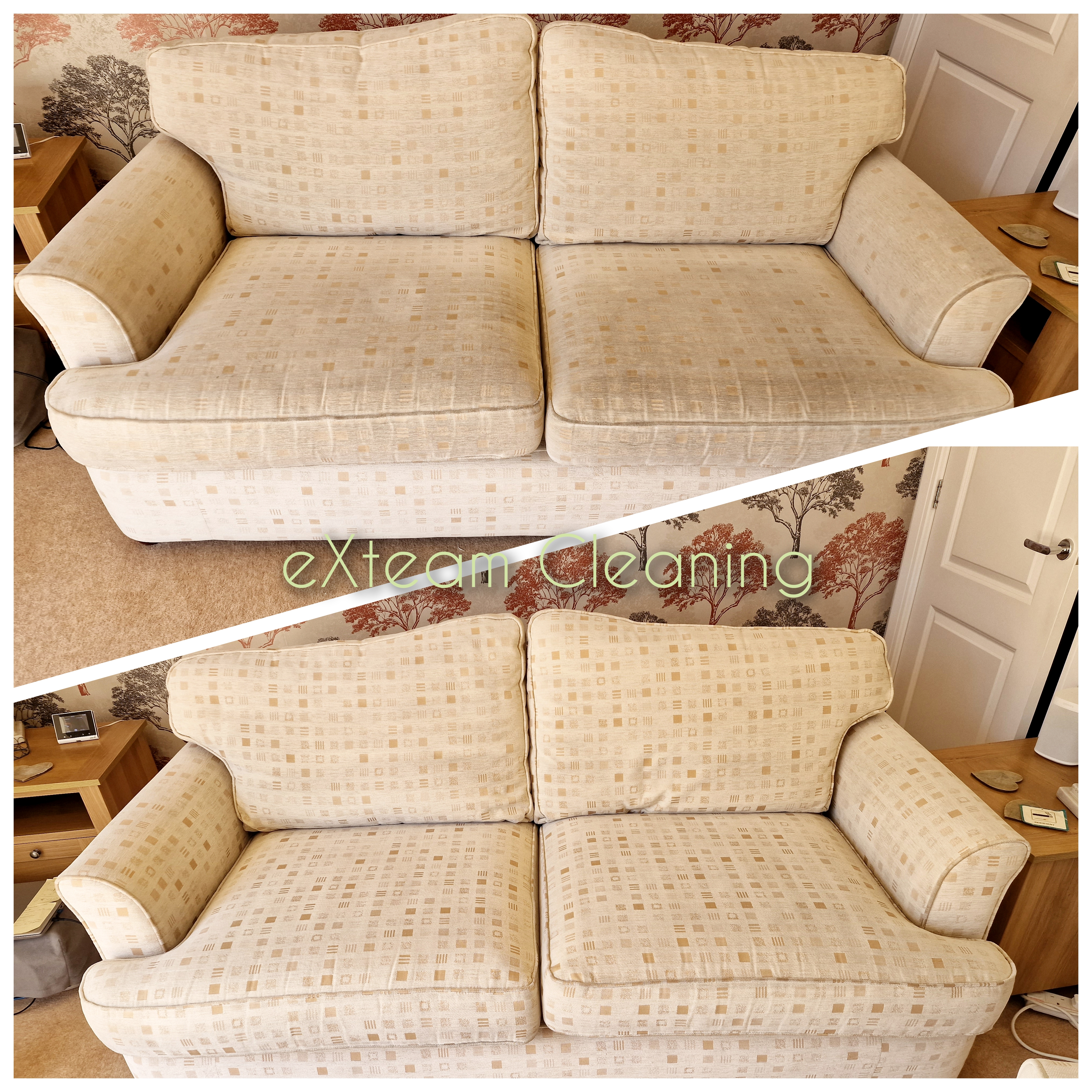
Family-run since 2015, eXteam Cleaning operates to defined professional upholstery cleaning standards designed to protect textiles, dyes, seams and fillings, manage moisture responsibly, and deliver consistent, long-lasting results across residential and commercial furnishings.
Defined methods. Trained technicians. Consistent outcomes.
Quick Answer
eXteam Cleaning Standards
eXteam Cleaning follows defined professional upholstery cleaning standards built around fabric identification, dye stability checks where needed, controlled low-moisture application, high-recovery extraction, and verification of moisture and texture stability. Upholstery is treated as a layered textile structure — fabric, seams, backing, foam and fillings — so the standard is to prevent over-wetting, dye movement, seam-edge saturation, odour conditions, wicking, and texture distortion. This delivers predictable drying, consistent hygiene, and long-lasting results across residential and commercial furnishings.
How upholstery is assessed (fabric type + construction)
When and why dye stability testing is required
How moisture and recovery are controlled to protect fillings
How method selection is risk-based, not “one method fits all”
Designed to protect textile integrity — not deliver a rushed cosmetic clean.
Professional upholstery cleaning is moisture engineering — not surface cleaning.
Why Professional Upholstery Cleaning Standards Matter
Upholstery cleaning is a textile discipline, not a surface clean. Outcomes depend on what the fabric is made from, how it is dyed, how it is stitched — and what sits beneath the visible layer.
Unlike carpet, upholstery is layered construction. Fabric is supported by backing, seams, piping, foam, and internal fillings — all of which behave differently under moisture and chemistry. If control is lost, issues don’t simply “dry out”. Moisture can migrate into cushion cores, concentrate along seam edges, soften adhesives, and create odour conditions or texture distortion.
Professional standards exist to remove contamination without destabilising the item. That starts with identifying fabric type and construction, checking dye sensitivity where required, and selecting a method based on risk and material behaviour — not only soil level.
At eXteam Cleaning, every upholstery clean follows the same principle: controlled application, high recovery, and verification of moisture and finish stability. This is what protects fabric integrity, supports predictable drying, and preserves long-term appearance.
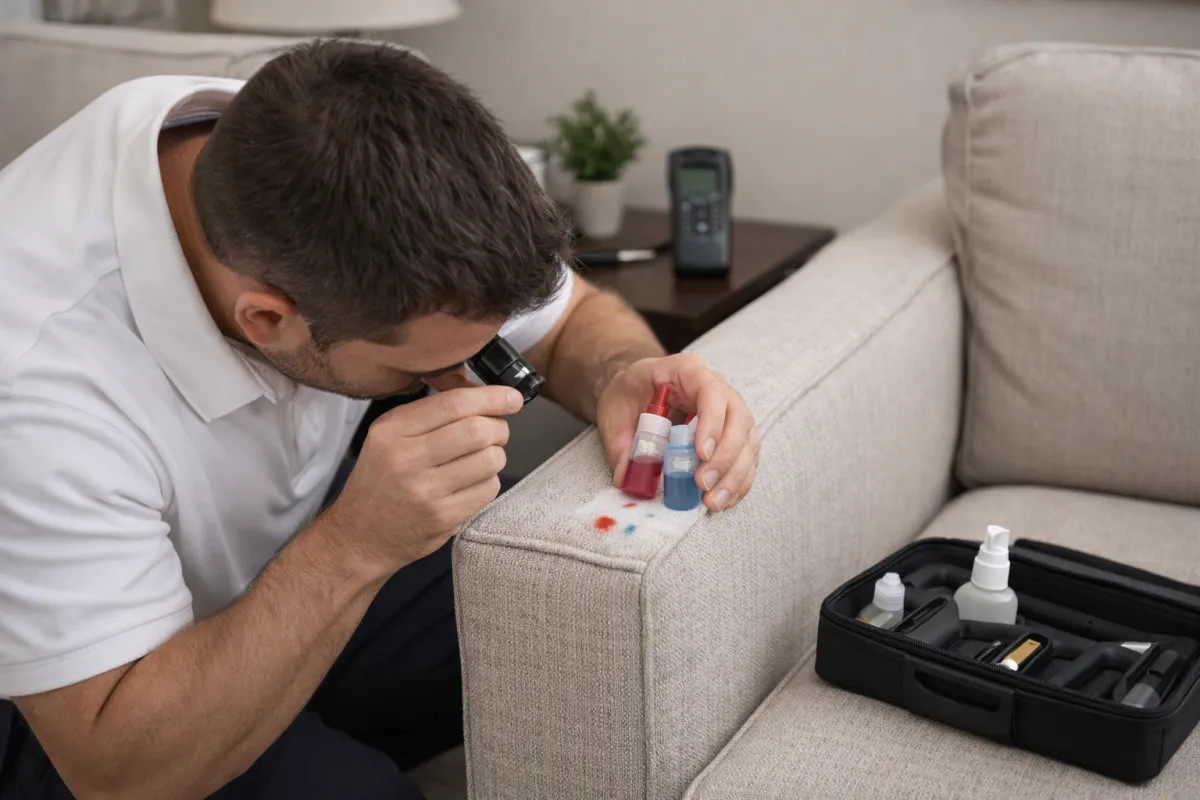
Professional upholstery cleaning begins with assessment of fabric type, dye stability, and construction to ensure safe method selection and controlled moisture use.
“This is where professional cleaning is decided — before any moisture is applied.”
The eXteam Professional Upholstery Cleaning Framework
Professional standards only work when they are applied consistently. At eXteam Cleaning, upholstery cleaning is delivered through a defined framework that governs decisions before, during, and after every clean.
This framework ensures each item is treated as a layered textile system — not a generic surface — and that choices are based on fabric behaviour, dye response, and structural risk, not speed or convenience.
1. Assessment Before Action
Every upholstery clean begins with inspection. Fabric type, weave density, stitching condition, cushion design, and visible wear are evaluated before any products are applied. Where required, dye stability testing is carried out so colour movement risks are understood in advance.
This stage identifies limitations early and ensures the chosen method fits the item, not the other way around.
2. Fabric-Led Method Selection
No single method suits all upholstery. Cleaning approach, moisture level, temperature control, agitation technique, and product selection are chosen based on fabric composition, colourfastness, and construction.
This prevents avoidable issues such as shrinkage, texture distortion, residue build-up, or prolonged drying that can occur when upholstery is cleaned like carpet.
3. Controlled Execution
Cleaning is carried out using professional tools and controlled application. Soil is loosened safely, cleaning agents are managed carefully, and recovery is prioritised to prevent over-wetting.
Work is carried out methodically with attention to contact zones, seams, armrests, and heavily used areas — ensuring consistency across the full item, not just visible panels.
4. Verification & Finishing
Once cleaning is complete, upholstery is reviewed for consistency, moisture levels, fabric stability, and remaining concerns. Finishing steps are applied where appropriate to support texture setting and even drying.
Any permanent wear or non-removable staining is clearly explained so expectations remain aligned with professional standards.
This framework ensures that every upholstery clean is planned, controlled, and verified — not improvised.
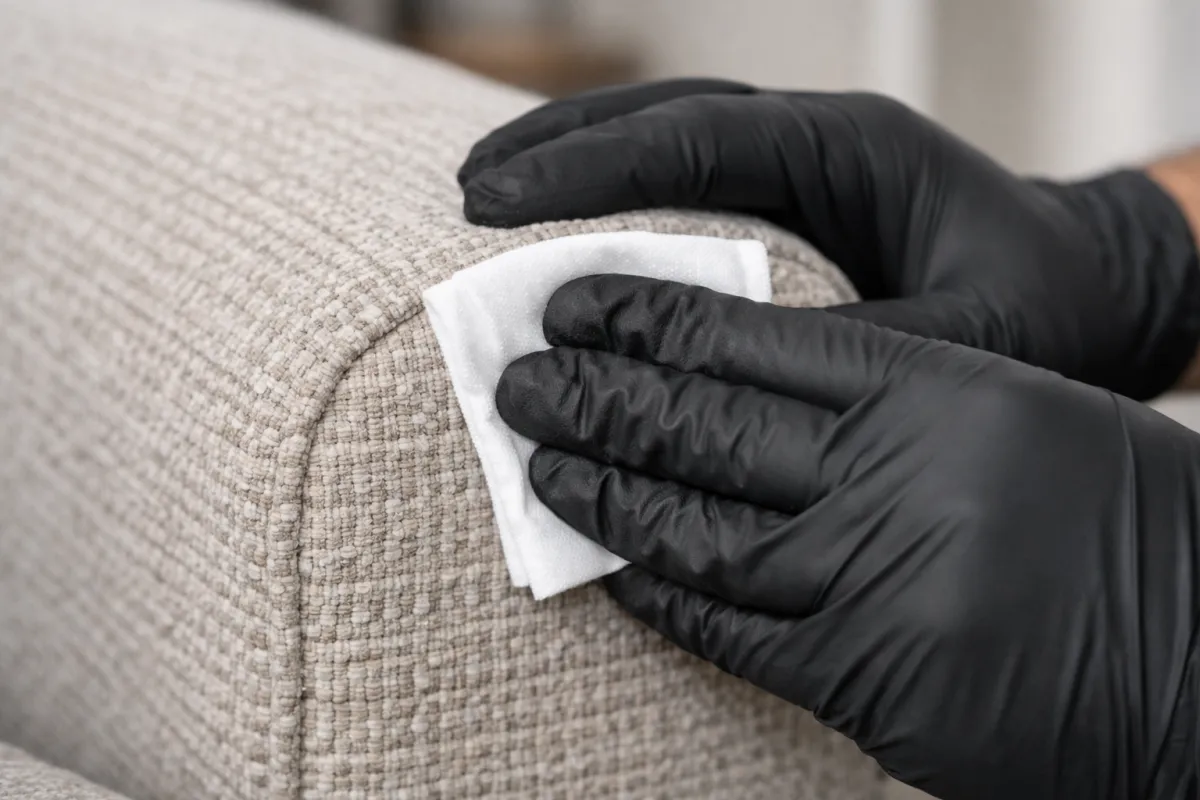
Fabric inspection and dye stability testing before cleaning — method selection is based on textile behaviour, seam construction, and moisture risk, not guesswork.
Key standard: Moisture is controlled at seams and cushion edges to prevent over-wetting and wicking.
Equipment, Methods & Moisture Control
Professional upholstery cleaning is defined by control. Upholstery isn’t a single surface — it’s layered textile construction over seams, backing, foam, and internal fillings. Because of that, moisture cannot be treated as superficial.
If application is too heavy or recovery is too weak, water can migrate into cushion cores, concentrate along seam edges, and remain trapped where airflow is limited. This is where the real risks begin — prolonged drying, odour conditions, and instability in the fabric finish.
For this reason, household and rental machines rarely meet upholstery standards. Limited suction and inconsistent application often leave fabrics over-wet, drying times extended, and residues more likely to remain beneath the surface rather than on it.
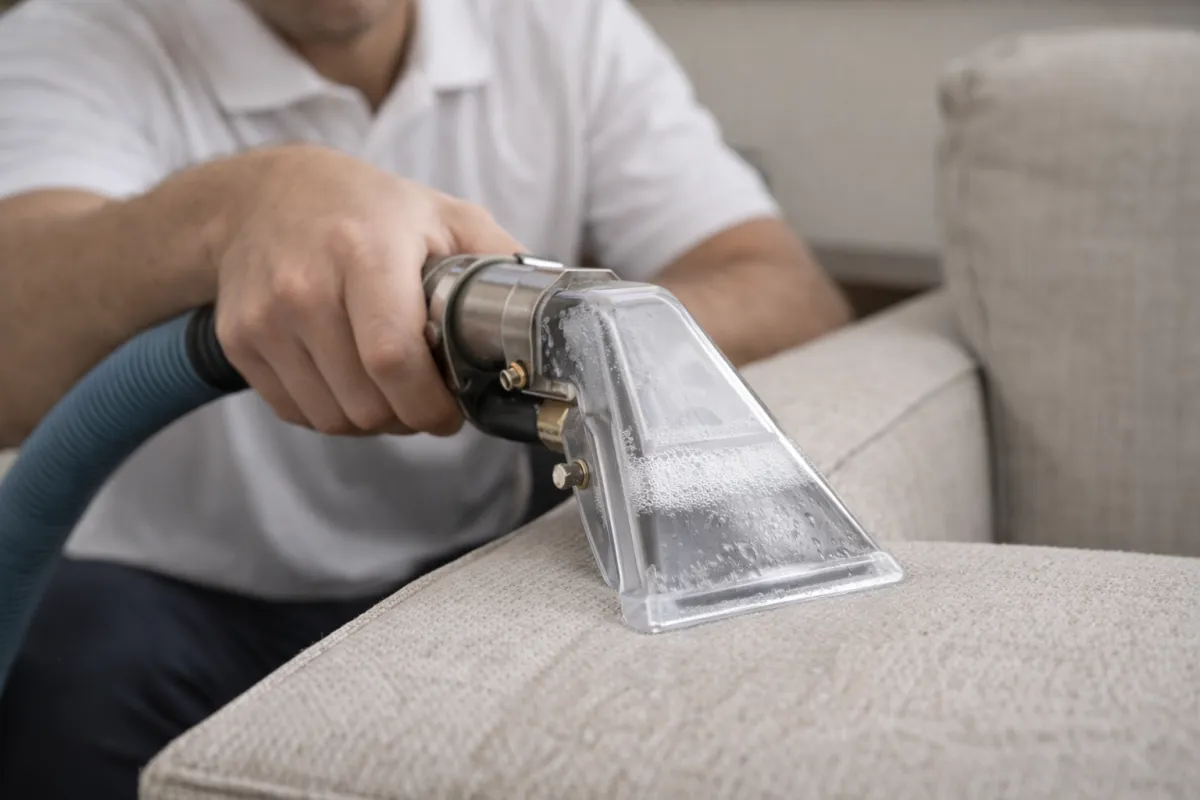
At eXteam Cleaning, upholstery work is carried out using professional systems and upholstery-specific tools designed for controlled application and high recovery. This allows contamination to be removed without saturating the construction layers below the fabric. In upholstery cleaning, recovery isn’t a final step — it is the discipline that governs the entire method.
Method selection is equally fabric-led. Some textiles tolerate controlled extraction well; others require low-moisture techniques, specialist application patterns, or modified rinsing to protect dye stability and surface texture. Agitation, dwell time, and finishing approach are adjusted to suit weave type, dye behaviour, and construction.
Moisture is managed continuously, not at the end. By controlling what is introduced — and maximising what is recovered — drying times become predictable and risks such as over-wetting, wicking, and seam-edge saturation remain within safe professional limits.
Professional outcomes come from controlled processes — not excessive water or aggressive cleaning.
Professional upholstery cleaning is not cosmetic — it is a structured restoration process designed to protect hygiene, comfort, and textile longevity.
Not all upholstery can be cleaned the same way. Fabric composition, weave structure, dye type, backing materials, cushion fillings, and construction methods all influence how cleaning should be approached. Professional standards exist to manage these variables and reduce risk — not to force a one-method outcome.
Natural fibres such as cotton, wool blends, linen, and silk can react very differently to moisture and chemistry than synthetics. Some fabrics are absorbent and prone to shrinkage or cellulosic browning if over-wet. Others are more stable but may retain oily contamination that requires precise product selection and residue control. Velvet, chenille, and textured weaves often require specialist finishing to prevent pile shading, nap distortion, or flattening.
Construction matters just as much as fabric. Seams, piping, stitched edges, buttoning, and cushion inserts all behave differently during cleaning. Where airflow is restricted or fillings are dense, moisture can remain trapped longer — increasing the importance of controlled application and seam-safe recovery.
Previous cleaning history also affects behaviour. Residues from earlier treatments, inappropriate stain removers, and past over-wetting can change how a fabric responds during professional cleaning — including increased risk of dye movement, re-soiling, or wicking. Identifying these factors early prevents avoidable complications and supports realistic expectation-setting.
By applying fabric-aware methods and professional risk management at every stage, upholstery cleaning prioritises preservation as well as cleanliness.
Professional upholstery cleaning is defined by what we prevent — shrinkage, dye movement, seam distortion, and cushion-core saturation.
Our Professional 12-Step Upholstery Cleaning Framework
At eXteam Cleaning, professional upholstery cleaning is delivered through a structured, method-led framework.
This 12-step process is designed to manage hygiene, moisture, fabric safety, and long-term upholstery performance — not just appearance.
Assessment & Preparation
Each item is inspected to confirm fabric type, weave, dye behaviour, construction, cushion filling, seam condition, and any risk factors that influence method selection and moisture limits.
Loose debris, crumbs, grit, and fine particulate are removed through careful vacuuming and crevice detailing. This prevents abrasive particles being driven into fibres during agitation and improves extraction efficiency before any moisture is introduced.
Targeted Cleaning & Extraction
Pre-treatments are selected based on fabric type, contamination profile, and risk level — not a one-product approach. Solutions are applied to loosen bonded soils on contact zones (armrests, headrests, cushions) while protecting dye stability and finish.
Gentle, fabric-safe agitation is used where appropriate to distribute pre-treatment evenly and release embedded soil without stressing fibres. Technique is adjusted to suit weave sensitivity, textured surfaces, and seam edges to prevent distortion.
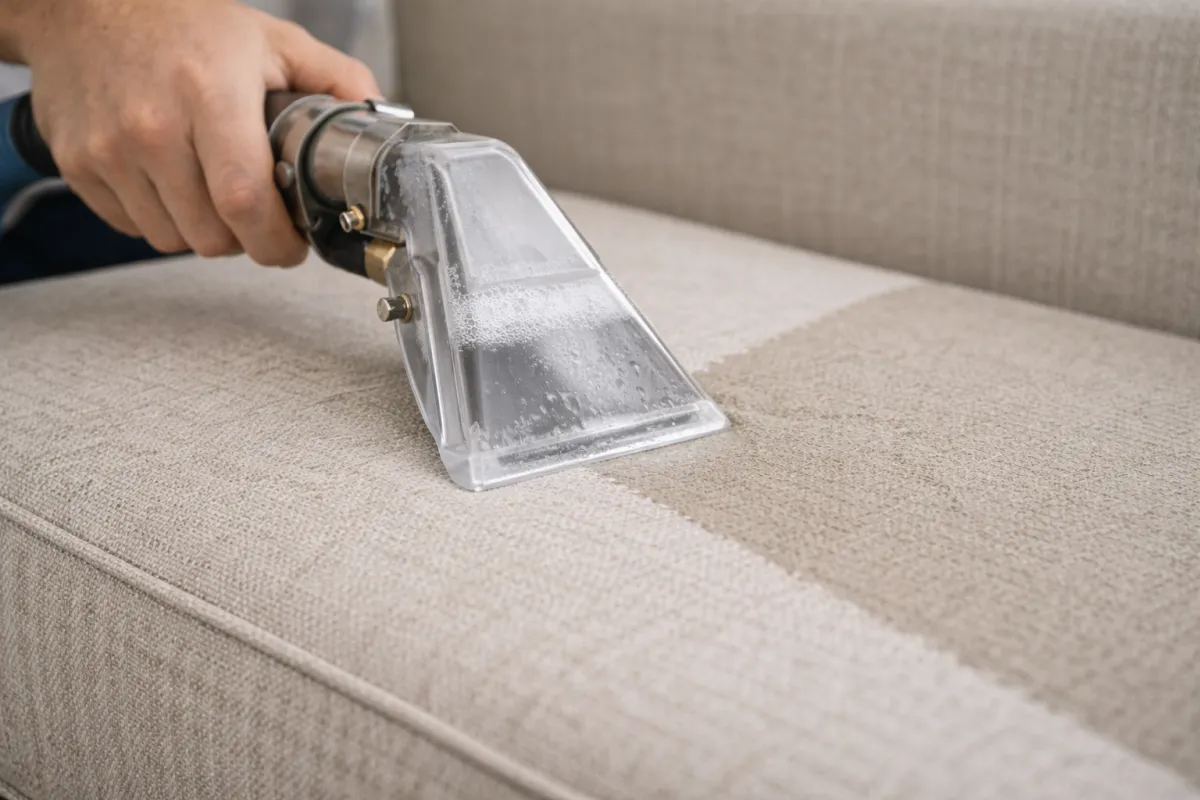
Where suitable, controlled Hot Water Extraction is applied using upholstery tools designed for precision moisture control and high recovery. This removes suspended soil while minimising saturation risk to seams, backing, cushion cores, and internal fillings.
Neutralisation & Finishing
Fabrics are rinsed where required to remove suspended soils and cleaning residues from within the textile structure. Residue control reduces sticky build-up that attracts dirt, prevents rapid re-soiling, and supports long-lasting results.
Where necessary, odour-neutralising treatments are applied to address residual odours at fibre level — particularly from pets, spills, or long-term embedded residues. Treatments are selected to remain fabric-safe and moisture controlled.
Finishing techniques are applied to stabilise texture and restore uniform appearance — particularly on pile and textured fabrics. This reduces shading risk, supports even drying, and helps preserve the natural “hand-feel” and finish of the upholstery.
Upholstery is checked for uniformity, remaining areas of concern, moisture expectations, and finish stability. Particular attention is given to seam edges and cushion zones where retained moisture can affect drying performance or contribute to wicking.
Clear drying guidance is provided to reduce disruption and support safe drying. Ventilation and airflow recommendations are tailored to fabric type and cushion density to minimise slow drying, odour conditions, and wicking risk.
After-care guidance is provided to preserve results and extend fabric life. This includes safe vacuuming routines, cushion rotation, spot response advice, and practical recommendations to reduce premature re-soiling in high-contact areas.
Where appropriate, technician notes are recorded on pre-existing wear, dye loss, permanent staining, and treatment outcomes. This supports transparency, consistency, and accountability — ensuring results align with defined professional standards.
Hot Water Extraction (sometimes referred to as deep steam cleaning, also known as thermal extraction) is one of the professional upholstery cleaning methods used by eXteam Cleaning where fabric type and construction allow.
It combines controlled heat, calibrated pressure, professional agitation, and high-vacuum recovery to remove embedded contamination while carefully managing moisture, dye stability, and textile safety.
Method selection for upholstery is always fabric-led and risk-assessed. Where Hot Water Extraction is not appropriate, alternative low-moisture or specialist methods are used in line with professional standards to protect seams, fillings, and finish.
Verification, Accountability & Professional Responsibility
Professional standards do not end when cleaning is complete. Verification and accountability are essential to confirm the work has been carried out correctly and that outcomes align with professional expectations — not just immediate appearance.
Once cleaning is complete, upholstery is inspected for consistency, safe moisture levels, and stability of finish. Particular attention is given to seam edges, contact zones, and cushions, where retained moisture can affect drying performance or texture. Finishing techniques are applied where appropriate to support even drying and preserve fabric appearance.
Clear communication is part of professional responsibility. Where permanent wear, pre-existing damage, dye loss, or non-removable staining is present, this is identified and explained. Professional cleaning improves hygiene and appearance, but it does not reverse structural wear or material loss — and standards require transparent expectation-setting.
Accountability also means ownership of the work. Upholstery cleaning is carried out by trained, insured technicians operating within defined methods rather than improvised approaches, supporting consistent outcomes across items and environments.
Standards are upheld not only by how work is done, but by how results are verified, documented, and explained.
Professional results rely on controlled application, correct recovery, and consistent technique to prevent residue, slow drying, and fabric distortion.
— eXteam Cleaning Professional Standards
Upholstery Cleaning Standards FAQs
Short, clear answers based on professional method-led upholstery cleaning standards.
Professional upholstery cleaning standards are the methods and controls used to assess fabrics correctly, select the safest cleaning approach, manage moisture and residues, and verify outcomes after cleaning. They exist to protect textile integrity and construction layers (seams, backing, foam and fillings), reduce risks such as over-wetting or dye movement, and deliver consistent hygiene with predictable drying times.
Yes — when professional moisture control and recovery standards are followed. Upholstery is cleaned using controlled application and upholstery-specific tools designed for high recovery, so moisture does not saturate cushion cores or collect along seam edges. Method selection is fabric-led, and where extraction is not suitable, low-moisture or specialist methods are used to protect structure and drying performance.
Odour after cleaning is usually linked to over-wetting, poor recovery, or contamination trapped in deeper layers such as foam and fillings. When moisture remains in cushion cores or seam edges, drying can be slow and odour conditions can develop beneath the surface. Professional standards prevent this by prioritising controlled moisture use, strong recovery, and verified drying guidance.
Not always. Many stains can be improved or removed, but outcomes depend on fabric type, dye stability, stain chemistry, and how long contamination has bonded to the fibres. Some marks are permanent due to dye loss, bleaching, wear, or fibre discolouration. Professional standards require honest assessment and clear expectation-setting before and after cleaning.
Clear standards. Honest expectations. Professional outcomes.
How These Standards Support Our Upholstery Cleaning Service
The professional standards outlined on this page are not theoretical. They form the basis of how our upholstery cleaning service is planned, delivered, and verified in real homes and commercial environments.
Standards guide assessment before any moisture is introduced, determine fabric-led method selection, and govern how dye stability, seams, cushions, and recovery are managed throughout the process. Outcomes are verified against professional expectations — not judged on appearance alone.
Service-specific details — such as availability, pricing structure, and common questions — are covered separately on our upholstery cleaning service page.
When to Seek Professional Advice Before Upholstery Cleaning
While professional standards guide every upholstery clean, some situations benefit from discussion before work is carried out. Factors such as delicate textiles, antique or specialist furniture, previous water exposure, heavy staining, or pet-related contamination can influence method selection and realistic outcomes.
Seeking advice in advance allows risks to be identified and expectations to be aligned — particularly where items have sentimental value, specialist construction, or a history of unsuccessful cleaning. In upholstery, the key considerations often include dye stability, seam condition, cushion core sensitivity, and whether low-moisture methods are more appropriate than extraction.
Professional advice does not obligate a booking. Its purpose is to ensure upholstery cleaning is approached responsibly, with clarity around what can be achieved — and how best to protect the item involved.
Clear communication before cleaning is a core part of maintaining professional standards.
We are eXteam Cleaning, a family-owned West Sussex business and your friendly neighbours. We're dedicated to eco-friendly carpet and sofa cleaning using a powerful, low moisture steam method recommended by top carpet manufacturers, ensuring your satisfaction and a healthier planet.